A Dry-Stone Wall as a Record of the Field
A field wall is more than a boundary: its stones, bends and repairs record how rural land was used. A close-reading routine helps you notice those decisions without treating working countryside as a museum.
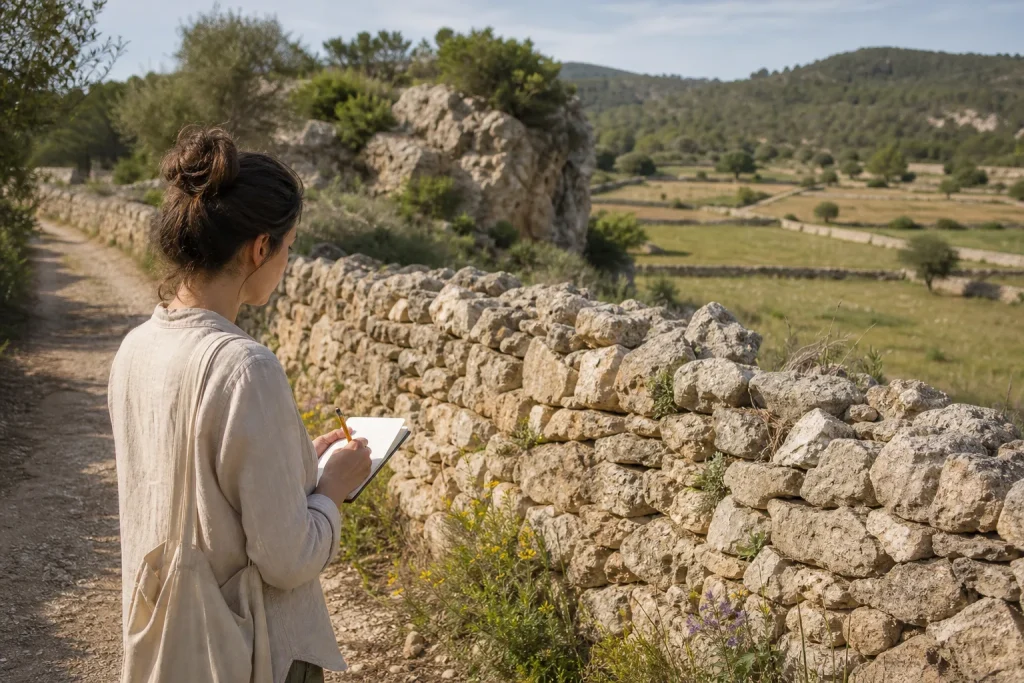
The common mistake is to see an old field wall as a picturesque edge and walk straight past it. That misses the useful part: the wall records where people chose to draw a boundary, what stone they had to hand and how they made uneven ground workable. It also risks treating a working landscape as scenery, which is an unhelpful way to meet someone else’s land.
On Ibiza, dry-stone walls belong to a rural fabric of fields, tracks and terraces shaped by local stone and practical needs. They were built without mortar, but that does not make them casual piles. Their lines and repairs can tell a careful visitor how a field was organized and how the terrain influenced its use. Give the wall a week of short, respectful observations rather than one hurried glance.
Before you start, where can you look?
Choose a public path or a permitted route that passes a wall without requiring you to cross a field or enter private land. A map can help distinguish a public track from a farm access road, but signs and gates matter more than a tempting shortcut. If a route is unclear, choose another one.
Take a small notebook and a pencil, or use a phone to record notes. You do not need tools for touching or moving stones. Avoid climbing on the wall, leaning against it or clearing plants from its joints; even a loose stone may be doing more work than it appears to.
Plan several brief visits across a week, if your route and the weather permit. The aim is not to cover a long distance. It is to look at one accessible stretch closely enough to notice how its form changes.
On the first visit, what does the line enclose?
Stand back from the wall and follow its direction with your eyes. Does it run straight, bend around a slope, turn near a track or meet another wall at an angle? Note the shape without assuming that every change marks a property line; walls may also divide fields, guide movement or respond to the ground.
Look at what lies on either side. A level plot, a rocky rise, a cultivated patch and a path each make different demands on a boundary. A wall that follows a contour may have been easier to build and maintain than one set directly across a steep slope. The terrain is not a backdrop here; it is part of the reason the wall takes its particular course.
Imagine a visitor following a public lane past a wall that bends around a rocky outcrop. If the visitor records that bend and observes that the field beyond it is more level, the notes can support a cautious reading: the line may have accommodated the land rather than imposed a neat geometric border. The observable result is a more accurate description, not a claim about the original builder’s exact intention.
On the second visit, what stone did the field provide?
Look at the visible stones from a respectful distance. Notice whether they are mostly angular or rounded, large or small, and whether their faces appear roughly similar. Local stone commonly supplied the material for field boundaries, so a wall can reflect what was available nearby as much as any ideal building pattern.
Do not turn that observation into a geological verdict from a glance. Weathering, repairs and the wall’s position can alter what you see. Instead, record simple details: “mixed sizes,” “roughly flat faces,” or “larger stones near the base.” Those phrases keep the observation useful without pretending to identify every rock.
Pay attention to the base and upper edge. Larger stones near the bottom can help anchor a structure, while smaller stones may fill gaps higher up. Yet a wall is assembled from individual choices, and later repairs can introduce different sizes or shapes. A tidy rule imposed on every section would erase the very evidence you came to notice.
Midweek, how does the wall deal with a slope?
Where the ground rises or falls, examine the wall’s height and the land immediately beside it. A wall may retain soil on one side, separate plots at different levels or simply trace a contour. Look for changes in the ground rather than deciding from the wall alone what its function must be.
Terracing is one way rural land can be made more usable on sloping ground. A stone structure may help hold a level area, but a field wall is not automatically a terrace wall. The distinction matters: a boundary can divide land without retaining much soil, while a retaining structure has a more direct relationship to the slope above it.
Check whether the ground above the wall sits noticeably higher, whether the wall face appears to hold back soil, and whether another level field or terrace continues beyond it. If those clues are absent, describe what you can see rather than assigning a function. “Wall follows a slope beside a level patch” is more reliable than “terrace” when the evidence is uncertain.
Later in the week, what do repairs reveal?
Look for changes in stone size, colour, alignment or surface condition. A small section that differs from its neighbours may indicate repair, rebuilding or simply a change in the material at that point. A visible seam can mark work done at another time, though it cannot tell you when or by whom.
Notice whether the upper stones form a consistent line or rise and dip. A dip may reflect settling, damage or an intentional response to uneven ground. Do not test the structure by pressing stones or stepping onto it. The most considerate inspection is the one that leaves the wall exactly as you found it.
Vegetation can offer clues, but it complicates the reading. Roots and grasses may grow in joints, and their presence does not prove that a section is abandoned or unstable. If the wall is partly obscured, note that limitation and move on rather than pulling plants away for a better view.
What should you write down each time?
Keep the record short and consistent. A few observations made at the same stretch are more useful than a page of guesses gathered while walking past several unrelated walls. Include the route context so you can distinguish what you saw from what you inferred.
- Location: note the public path, nearby landmark or map reference without publishing details that could direct people into private land.
- Line: record whether the wall runs straight, bends, follows a contour or meets another boundary.
- Material: describe visible stone shapes, sizes and any apparent change along the stretch.
- Ground: note whether the land is level, sloped, terraced or uneven on either side.
- Condition: mark obvious gaps, dips, repairs or plant cover without touching the structure.
- Interpretation: separate a visible fact from a possible explanation, using words such as “may” where the evidence is incomplete.
A simple two-column note can help: “I can see” on one side, “This might suggest” on the other. Keep the first column factual. The second is where a careful, qualified interpretation belongs.
At the end of the week, how do the clues fit together?
Review the notes in sequence. A wall that bends around rough ground, uses mixed local stone and meets a level field may show how boundary-making adapted to the available terrain and materials. That is a useful reading of practical choices, not a reconstruction of a particular household’s plans.
Compare sections rather than forcing them into one explanation. One part may mark an edge between plots; another may retain soil; a third may have been repaired later. Rural structures often accumulate purposes and alterations. Their apparent simplicity can conceal a long history of small decisions.
Keep the final account modest. Say where you stood, what you observed and which interpretation seems plausible. Avoid naming an owner, dating a wall or claiming a function unless reliable local information supports it. A field wall can tell you much about how land was shaped, but it is not a written archive with every question answered.
Before leaving, check that you have stayed on the public route and taken nothing from the site. The most useful record is one that preserves both the wall’s details and the working landscape around it: a boundary read with care, then left undisturbed.
Stay with the subject

The Sound of a Festive Gathering
At an Ibizan village celebration, music is not a show placed in front of a crowd.…

The Village Square After the Shops Close
On Ibiza, the village square shifts from practical thoroughfare to shared room as the day slows.…