The Village Square After the Shops Close
On Ibiza, the village square shifts from practical thoroughfare to shared room as the day slows. Its changing use depends on shade, seating, familiar routines and the people who stay.
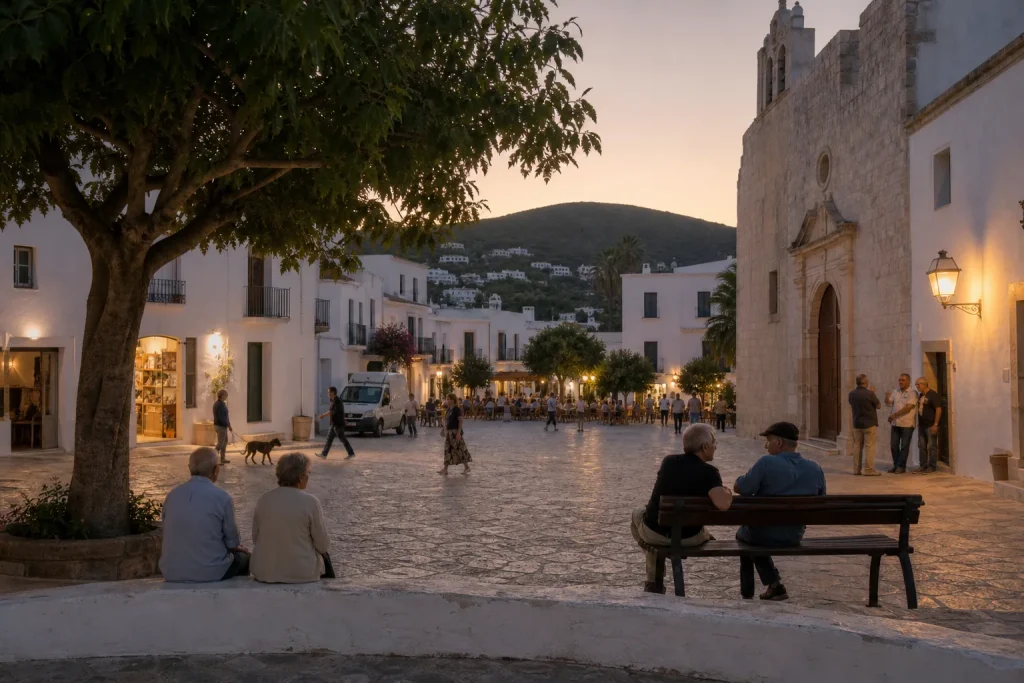
The common mistake is to treat an Ibizan village square as scenery between the church and a café. By doing so, visitors miss its quieter work: carrying people through the day, then giving them somewhere to stop once errands are done and shutters come down.
That change is not announced. It appears in small decisions about where to sit, whom to greet and how long to remain. Here are five ways to read the square as it moves from passageway to gathering place.
1. The morning square is built for crossing
Early in the day, the square often belongs to people with somewhere specific to be. A resident cuts across on the way to a shop; a delivery vehicle pauses near an entrance; someone walks a dog along the edge rather than through the middle. The open space makes those routes legible.
Look at the ground as well as the buildings. Paving that continues without a raised barrier lets a square work as an extension of the street, while doorways and narrow lanes funnel movement toward particular corners. In smaller villages, the plaza may be less a single room than a meeting point between the church, municipal buildings, homes and everyday businesses.
At this hour, standing aside matters. A visitor who stops in the center to frame a photograph can interrupt the ordinary route, especially where cars and pedestrians share the space. Move to a wall or bench before taking in the view.
2. The shade changes who can stay
As the sun climbs, a square’s useful geography shifts. A tree, an arcade or the shadow cast by a church wall can turn one side into a comfortable place to wait, while the exposed paving becomes something to cross quickly. Seating is only part of the invitation; shade makes lingering possible.
Notice how people arrange themselves. A bench may serve a person resting alone, while a low wall offers a place for two neighbors to stop without making an appointment of it. The distance between seats, and whether they face one another or the street, quietly shapes the kind of conversation that can happen.
Say you arrive in a village after a walk and find the sunny benches empty but a shaded ledge occupied. If you sit at the far end and leave room for others to pass, you can rest without treating a shared spot as private territory. The result is a brief pause that fits the square’s existing rhythm.
3. Closing time loosens the square from commerce
Shops and cafés give a square much of its daytime traffic, but their closing changes the balance. The square does not become empty so much as less directed: fewer people arrive with a purchase in mind, and more can remain simply because they know someone there.
This is why a shopfront can matter even after its door is shut. It has brought neighbors into repeated contact during the day, creating the familiarity that makes a greeting or a short exchange feel natural later. The social life of a square is often supported by ordinary commercial routines, not separate from them.
Watch the edges after shutters close. People may stand near a doorway to finish a conversation, sit on a step, or cross toward the church before heading home. These are small uses, but together they make the plaza feel occupied without requiring a formal event.
4. Familiar greetings turn a place into a meeting point
A gathering does not need a host. In a village square, people can arrive at different times, recognize one another, and form a conversation that grows or thins as the evening moves on. A nod may be enough to join; a brief exchange may be enough to leave.
For a visitor, the distinction between welcoming public space and private social circle can be hard to read. A quiet greeting is usually less intrusive than stepping directly into an ongoing conversation or photographing people at close range. Sit where seating is clearly public, keep routes open and let others set the pace of interaction.
Imagine you pause on a public bench while two residents talk nearby. You offer a polite hello, then return to your book when their conversation continues. That leaves room for a friendly response without assuming that every exchange is an invitation to join.
5. A gathering can change the square without changing its character
On some evenings, the square may accommodate a local meeting, a small performance or a seasonal celebration. Chairs appear, people arrive from nearby streets, and the usual routes bend around the activity. The plaza temporarily takes on a shared purpose that is more visible than an everyday conversation.
Yet the event depends on familiar features: an open center, places to sit, nearby homes and a route back into the village. The difference is not that the square has become a stage for visitors. It is that residents have made a public place serve a particular occasion, then can return it to its ordinary use.
If you encounter an event, follow posted directions and avoid blocking entrances or pathways. If there is no clear invitation to participate, watching discreetly from the edge is a respectful choice.
When you leave, notice which way people disperse: toward a lane, a café, a doorstep or the church. That last movement is part of the square’s daily life too. Its most useful feature may be the way it lets people pause together, then carry the conversation home.
Stay with the subject
The Sound of a Festive Gathering
At an Ibizan village celebration, music is not a show placed in front of a crowd.…

From Market Stall to Table: The Shape of an Ibizan Food Tradition
An imagined day of buying, preparing and sharing sofrit pagès shows how an Ibizan dish takes…