From Market Stall to Table: The Shape of an Ibizan Food Tradition
An imagined day of buying, preparing and sharing sofrit pagès shows how an Ibizan dish takes its shape from local produce, seasonal choices and the people around the table.
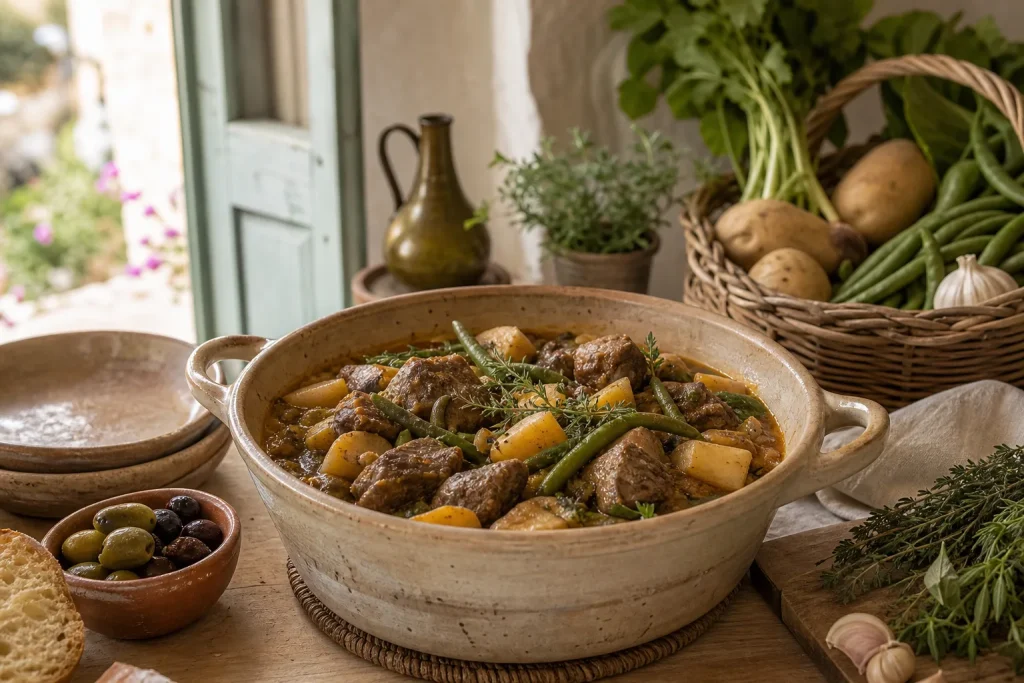
The common mistake is to treat a traditional dish as a fixed recipe: buy the listed ingredients, follow the sequence and expect the same result. In Ibiza, that can flatten the very things that give a meal its character: what is ready at the market, what a household has kept, and who is coming to eat. The cost is a plate that may be perfectly serviceable but detached from the place it claims to represent.
Consider sofrit pagès, a substantial country dish associated with festive meals and family gatherings. Its ingredients and methods vary between households, and versions can bring together meats, potatoes and vegetables with herbs and spices. The point is not to declare one version authentic. It is to follow an invented situation and see how the choices around the pot connect food to its setting.
What is ready at the market?
Say Marta, an invented cook in Santa Eulària, is preparing lunch for relatives on a day when the local market has produce from nearby farms alongside goods brought in from elsewhere. She has a general idea of making sofrit pagès, but no shopping list that dictates every ingredient. She first asks what is in season and looks at the vegetables before deciding how the dish will take shape.
She chooses potatoes, a handful of green beans and a small bunch of fresh herbs. The beans are available and look sound; another week, she might find a different vegetable or decide to leave them out. This is not a test of culinary purity. It is an ordinary adjustment to what is ready, affordable to the household and suitable for the meal.
A market visit makes those decisions visible. The stallholder can identify what has come from nearby and what has travelled farther, while the produce itself offers clues: firm potatoes, crisp beans, herbs that still carry their scent. Marta does not need to turn that conversation into a claim that every item is local. She can simply buy with a clearer sense of where the ingredients came from.
Ask what is in season before deciding what the pot needs.
Which ingredients belong in this version?
Back home, Marta checks what is already in the kitchen. Her relatives expect a generous dish, and she has meat set aside for the meal, along with potatoes and a few pantry staples. She decides to use those ingredients as the base, then add the beans and herbs she bought that morning.
That choice reflects a familiar feature of household cooking: tradition can be carried by a method and a set of expectations, not only by an exact inventory. One family may use ingredients another leaves out. A cook may draw on stored food, a garden, a market purchase or a neighbour’s offering. What matters in Marta’s version is that she can explain why each ingredient is there.
She also avoids making every ingredient compete for attention. Potatoes lend substance; green beans bring a fresh, savoury note; herbs help connect the dish to the kitchen garden and the surrounding landscape. If she added vegetables simply to make the pot look abundant, she could lose the balance she wants. A traditional dish need not contain every edible thing currently available.
How does the cooking follow the ingredients?
Marta begins by preparing the ingredients separately, keeping the potatoes ready for the later part of cooking and washing the beans and herbs. She browns the meat in a heavy pot, then builds the cooking liquid with the seasonings and ingredients her household uses. The sequence matters because the ingredients need different amounts of time and do not all improve by being added together.
Once the meat has begun to soften, she adds the potatoes and adjusts the liquid so they can cook without turning the pot into soup. The beans go in later, so they soften while retaining some shape. She tastes as she goes, correcting the seasoning rather than treating a remembered recipe as a command. The result should be hearty, but each ingredient should still be recognisable.
Her method is neither a restaurant procedure nor an archaeological reconstruction of an older kitchen. It is household knowledge being used in the present: a heavy pot, a steady heat, attention to timing and a sense of how the family likes its food. The tools are plain. The judgment is less so.
Who helps shape the meal?
As the pot cooks, Marta’s relatives arrive with bread and a bowl of olives. One asks whether the beans should have gone in earlier; another remembers a version made without them. The disagreement stays mild, partly because nobody has been appointed guardian of the only correct recipe. They are talking about variations they know, not voting on a verdict.
That exchange is part of the meal’s cultural setting. Recipes are passed on through watching, tasting and doing small jobs: peeling potatoes, sorting herbs, checking whether the meat is tender. A younger relative may learn the sequence without ever receiving a written formula. The conversation carries details a recipe card usually omits, such as when to add a particular ingredient or what the cook means by a sufficiently thick sauce.
For Marta, sharing the work also changes the practical decisions. There is enough help to peel and chop, but she still keeps one person responsible for the pot. Too many hands stirring at once would turn cooperation into traffic. The kitchen has its own quiet governance.
What does the finished dish say about its setting?
At lunch, Marta serves the sofrit pagès from the pot, with bread and olives alongside. The meal reflects the ingredients she could obtain, the season’s offerings, the household’s preferences and the work shared before everyone sat down. None of those details alone makes the dish Ibizan. Together, they give this particular version a clear connection to the island and the people eating it.
Imagine instead that Marta finds no good green beans at the market. She leaves them out, adds a little more potato from her pantry and tells her relatives why. The expected result is still a substantial shared lunch, though the texture and flavour shift. The change is visible and deliberate, not a failed attempt to reproduce an absent ingredient.
That distinction is useful for anyone trying to understand a food tradition. Ask where the ingredients came from, what could be substituted, who taught the method and which parts of the meal are shared. A dish can travel beyond its home, but its meaning is easier to retain when cooks explain the choices behind it.
Next time you encounter an Ibizan recipe, treat it as a record of decisions rather than a sealed formula. Find out what is available, cook with attention to the ingredients and leave room at the table for the people who know another version.
Stay with the subject

The Sound of a Festive Gathering
At an Ibizan village celebration, music is not a show placed in front of a crowd.…

The Village Square After the Shops Close
On Ibiza, the village square shifts from practical thoroughfare to shared room as the day slows.…